Ever wondered why the slower we move in Fitness PILATES, the harder it can feel?
You might think that the faster you move, the harder you're working. More repetitions, bigger movements, less time to rest… surely that's what makes a workout effective?
Well, think again!
When it comes to Fitness PILATES, slowing things down can be a game changer. In fact, some of the most effective work happens when you move less, not more. That tiny controlled movement, the extra second holding a position, or the effort it takes to slowly lower your leg can challenge your muscles far more than rushing through a series of repetitions. Fitness Pilates isn't a race, and it's certainly not about keeping up with the person next to you. It's about taking control, connecting with your body and making every movement count.
Because sometimes, the slower you go, the more you get out of it!
So, let's explore why slowing down could be one of the best things you do for your body.
Why Momentum and Gravity Matter
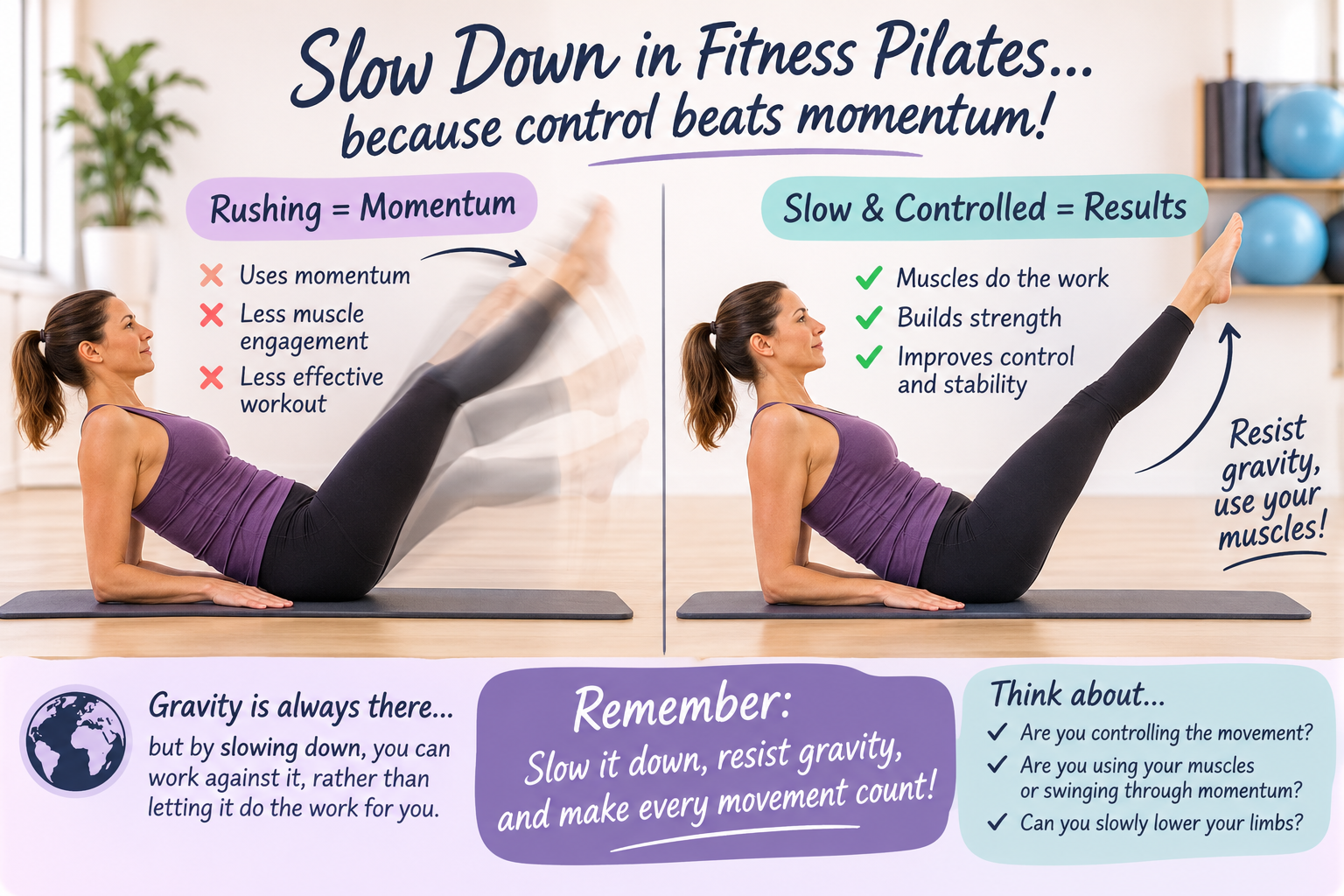
Here's something worth thinking about: Are your muscles doing the work, or are you letting momentum do it for you?
When we rush through an exercise, it's very easy to use momentum to carry us through the movement. We swing a leg, throw an arm, or quickly lift and lower our body without necessarily maintaining control. And whilst it might look like we're working harder, we're not always getting the best results. In Fitness Pilates, we want to minimise momentum and maximise muscular control.
Think about slowly lowering your leg towards the floor. If you let gravity take over, your leg may simply drop down. But if you resist gravity and control that downward movement, your muscles have to work throughout the entire range. It's the same when lifting a leg, lowering your arms or moving through a roll-down. Rather than allowing the body to swing, drop or bounce into position, we want to control both the movement and the return.
Gravity is always there, but how we work against it makes all the difference.
By slowing down, we give our muscles the opportunity to control the movement rather than relying on momentum to do the job.
This is particularly important during the lowering phase of an exercise (known as the eccentric phase), when muscles work whilst lengthening. Controlling this phase can be a fantastic way to develop strength and muscular control.
So next time you're tempted to speed up, think about this:
- Are you controlling the movement?
- Are you using your muscles or swinging through momentum?
- Can you slowly lower your limbs rather than letting gravity take over?
- Can you pause and maintain control before moving into the next repetition?
Remember, it's not just about getting from A to B. It's about how you get there.
Slow it down, resist gravity, eliminate unnecessary momentum and make every movement count!
So why is slowing things down so important?
1. Better muscle engagement
One of the biggest benefits of slowing down during Fitness Pilates is that you give your muscles time to do their job properly.
When we rush through an exercise, we can often use momentum rather than muscle control. By slowing the movement down, we encourage the correct muscles to engage, particularly our deep abdominal muscles, pelvic floor and stabilising muscles.
It's not about how many repetitions you do, but how well you perform each one.
2. Improving your technique and posture
Fitness Pilates focuses on alignment, posture and movement quality.
Taking your time allows you to concentrate on your positioning, breathing and technique. You become more aware of how your body is moving and can make small adjustments to improve your form.
Those little adjustments can make a huge difference!
Good technique also helps reduce unnecessary strain on the body and allows you to get more out of every exercise
.
3. Building strength through control
You don't need to move quickly to build strength.
In fact, controlled movements can make an exercise considerably more challenging. By slowing down the lifting, lowering or holding phases of an exercise, your muscles spend longer working under tension.
This helps develop muscular endurance, stability and strength without needing to rely on fast or high-impact movements.
Sometimes that slow, controlled movement is far more challenging than rushing through 20 repetitions!
4. Connecting movement with your breathing
Breathing is a really important part of Fitness Pilates.
When we slow down, we have more opportunity to coordinate our breathing with our movements. This encourages better control, helps us maintain core engagement and creates a greater awareness of how our body responds to exercise.
Rather than holding your breath or rushing through a movement, allow your breathing to guide you.
Breathe, move and connect.
5. Improving balance and stability
Slower movements challenge our ability to stabilise and control the body.
Whether we're working on one leg, holding a balance, moving through a standing exercise or performing a controlled floor-based movement, taking our time encourages the smaller stabilising muscles to work harder.
Over time, this can help improve balance, coordination and body awareness, all of which are important for everyday activities.
6. Less is sometimes more
We often associate a good workout with feeling exhausted, sweaty or completely out of breath.
But Fitness Pilates reminds us that exercise doesn't always need to be fast, intense or exhausting to be effective.
A smaller movement performed with precision can be incredibly challenging. You might only move a few centimetres, but if you're using the correct muscles and maintaining control, you're still working hard!
Remember, quality over quantity.
7. Giving your mind time to focus
One of the lovely things about Fitness Pilates is that it gives you the opportunity to switch off from the busyness of everyday life.
Slowing down encourages you to concentrate on the present moment, focus on your body and become more aware of how you feel.
It's your time to move, breathe and reconnect with yourself.
You don't need to compete with anyone, rush to finish or worry about what the person next to you is doing. Work at your own pace and listen to your body.
So, next time you come to Fitness Pilates...
Don't be tempted to rush!
Think about the quality of your movement rather than the number of repetitions. Focus on your breathing, engage your core, maintain good alignment and give each exercise the attention it deserves.
Remember:
- Slow doesn't mean easy.
- Small movements can be challenging.
- Control is more important than speed.
- Technique always comes first.
- Your body doesn't need to keep up with anyone else.
The real magic of Fitness Pilates happens when you slow down, tune in and move with intention.
Sometimes the biggest results come from the smallest, slowest movements.
So take your time, enjoy the process and remember...
It's not about how fast you move. It's about how well you move!