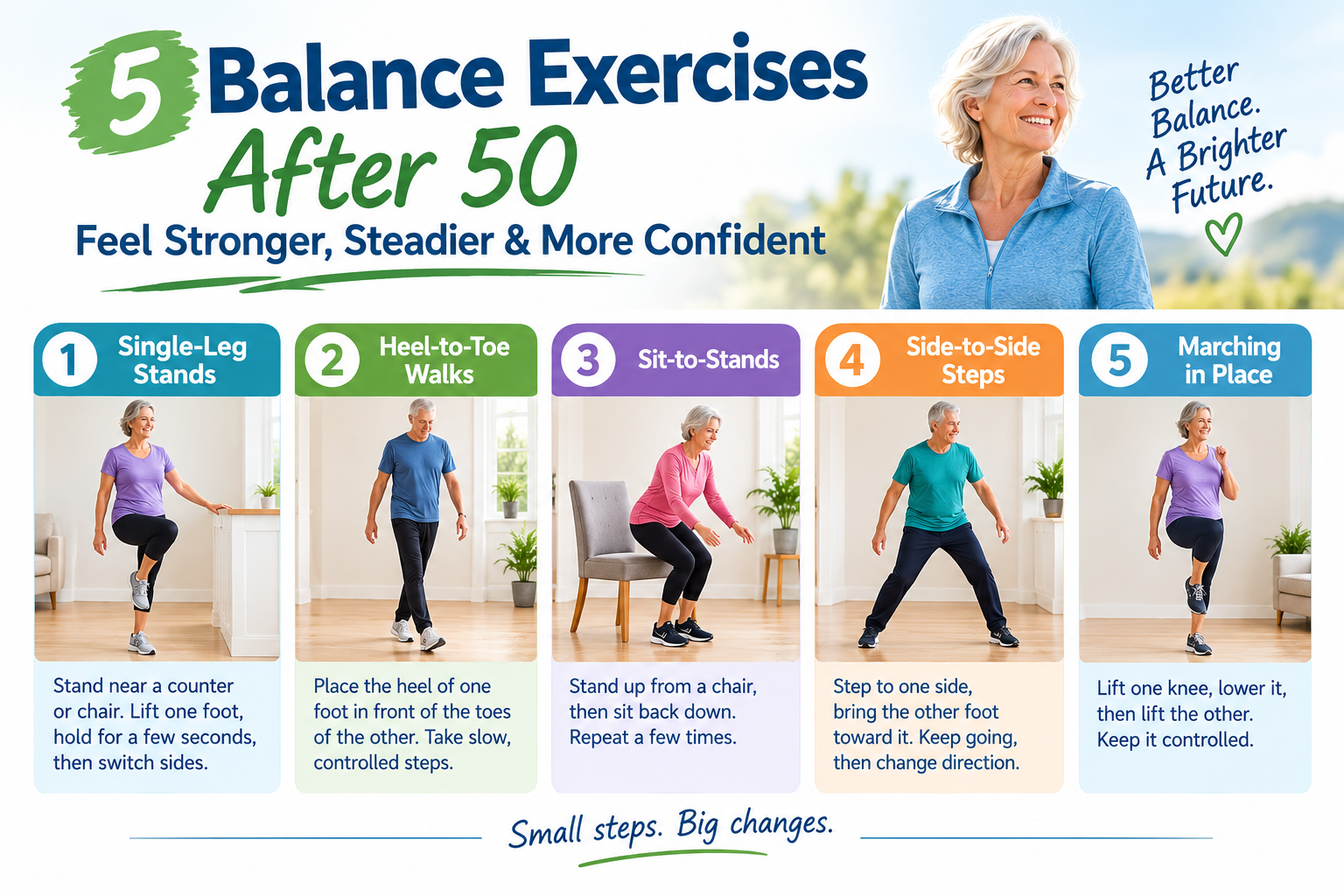
As we get older, staying strong is important — but there’s another area of fitness that deserves just as much attention: balance. The good news? Balance can be improved with regular practice.
What if one of the most important things you could work on after 50 has nothing to do with how much weight you can lift?
It might be your balance.
We often focus on strength, walking, cardio and flexibility as we get older. But balance deserves a place on that list, too.
Think about how often you rely on your balance without even realizing it.
- You stand up from a chair.
- You step over something on the floor.
- You walk across an uneven pavement.
- You reach for something on a high shelf.
- You get in and out of the shower.
- You turn around quickly when someone calls your name.
These everyday movements all require some combination of balance, coordination, strength and stability.
And here's the encouraging part:
You don't have to be naturally "good at balance" to improve it. Balance is a skill that can be practiced.
If you're over 50, adding a few simple balance exercises to your routine can be a practical way to work on your stability and confidence as you stay active.
- And you don't need a gym.
- You don't need expensive equipment.
- You don't even need to start without support.
Let's look at five simple exercises you can try.
What Are the Best Balance Exercises After 50?
The best balance exercises after 50 include single-leg stands, heel-to-toe walks, sit-to-stands, side-to-side steps and marching in place. These exercises can help challenge balance, coordination, lower-body strength and stability. Beginners should use a sturdy support surface when needed.
Now let's break them down.
1. Single-Leg Stands: A Simple Balance Challenge
The single-leg stand looks simple. That's exactly why it's such a useful exercise to include in your routine.
- Stand next to a sturdy counter, table or chair.
- Keep your body upright and slowly lift one foot from the floor.
- Hold for a few seconds.
- Lower your foot.
- Then repeat on the other side.
Make it easier - Keep one or both hands lightly supported on a stable surface.
Make it harder - As you become more comfortable, you can gradually reduce your reliance on your hands or increase the duration.
Remember: The goal isn't to see how long you can balance on one leg. The goal is controlled, confident movement.
2. Heel-to-Toe Walks: Practice Balance While Moving
Standing still isn't the only time you need balance. Walking requires it, too.
- For a heel-to-toe walk, stand upright and slowly place the heel of one foot directly in front of the toes of the opposite foot.
- Take another controlled step and repeat.
- Think slow and steady, rather than fast.
If you feel unstable, perform this exercise alongside a sturdy counter or other secure support.
Why try it? - It challenges your ability to control your body while moving and changing your position.
3. Sit-to-Stands: Turn an Everyday Movement Into Exercise
Here's an exercise you probably already do every day - getting out of a chair. Instead of thinking of it as simply getting up, you can use the movement as a simple exercise for your legs and hips.
- Sit in a sturdy chair with your feet firmly on the floor.
- Lean forward slightly and push through your feet to stand.
- Pause briefly.
- Then slowly lower yourself back into the chair.
- Repeat several times at a controlled pace.
Beginner modification - Use your hands on the chair or armrests for assistance if necessary. There's nothing wrong with making an exercise easier while you're building strength and confidence.
4. Side-to-Side Steps: Don't Forget Lateral Movement
Most of us spend a lot of time walking forward. But everyday life doesn't always happen in a straight line. Side-to-side stepping gives you an opportunity to practice moving laterally while staying controlled and stable.
- Stand upright with your feet roughly hip-width apart.
- Take a controlled step to one side.
- Bring the other foot toward it.
- Continue for several steps, then change direction.
Safety tip - Do this beside a kitchen counter or another sturdy support so you have something to hold if you need it.
5. Marching in Place: Simple, Effective and Easy to Modify
You don't need to go anywhere to practice balance. Simply march in place.
- Stand tall with your feet about hip-width apart.
- Slowly lift one knee.
- Lower it.
- Then lift the opposite knee.
- Continue alternating sides.
- Keep the movement controlled rather than rushing through the exercise.
If you're new to balance training, keep the knee lifts small and use a sturdy counter for support.
As your confidence improves, you can gradually increase the range of movement.
Why Is Balance So Important After 50?
Balance isn't just something you need during exercise. You use it throughout the day.
Good balance helps you control your body while standing, walking, turning, stepping and changing position.
It also works together with strength, mobility and coordination to support everyday movement.
If you're interested in how Pilates can support these areas over time, take a look at the long-term benefits of Pilates.
That's why balance training can be a valuable part of an active lifestyle as you get older.
Instead of waiting until balance becomes a noticeable problem, you can make it part of your regular routine now.
Balance is also one of the areas that can be supported through regular Pilates practice. Learn more about Pilates for balance as you age.
Do You Need Good Balance Before Starting Balance Exercises?
No. That's the whole point.
You don't have to be good at balance before you start practicing it. In fact, needing support is completely normal when you're beginning.
- Hold onto a sturdy countertop.
- Stand next to a stable chair.
- Use a wall for additional support.
- Start with a movement that feels manageable and gradually build from there.
Your starting point doesn't have to be your finishing point.
Maybe today you need to hold the counter with both hands. Later, you might only need one hand. Eventually, you may feel comfortable reducing your support. Progress can be gradual.
How Often Should You Do Balance Exercises?
You don't necessarily need a long workout to practice balance.
You can incorporate a few simple balance exercises into your existing fitness routine and practice them consistently.
For example, you might choose two or three exercises and perform them regularly before gradually adding more.
The important thing is to choose exercises that match your current ability and progress at a sensible pace.
You don't always need a long workout to stay active. If you're short on time, you might also enjoy AinyFit's 15-minute workout videos, which make it easier to fit movement into a busy day.
Quality matters more than trying to make every exercise difficult.
5 Balance Exercises to Save for Later
If you want a quick reminder, here are the five exercises again:
1. Single-leg stands
Challenge your ability to maintain stability on one foot.
2. Heel-to-toe walks
Practice controlled balance while moving.
3. Sit-to-stands
Work on a movement you use every day while challenging your lower body.
4. Side-to-side steps
Practice controlled lateral movement.
5. Marching in place
Challenge balance and coordination with a simple standing movement.
Save this list and come back to it whenever you need a simple balance workout idea.
A Quick Reminder: You Don't Have to Prove Anything
There's a temptation with exercise to turn everything into a competition.
- How many repetitions?
- How much weight?
- How long can you hold it?
But balance training doesn't need to work that way.
- If you can only stand on one leg for a few seconds, that's your starting point.
- If you need to hold onto the counter, hold onto the counter.
- If you need to perform fewer repetitions, do fewer repetitions.
Your goal isn't to impress anyone.
Your goal is to keep your body moving, build confidence and gradually become stronger and steadier.
Frequently Asked Questions About Balance Exercises After 50
What is the best exercise to improve balance after 50?
There isn't one single best exercise for everyone. Single-leg stands, heel-to-toe walking, marching, side steps and functional movements such as sit-to-stands can all challenge different aspects of balance and stability.
Start with exercises that are appropriate for your current ability and use support when needed.
Can you improve your balance after 50?
Yes. Balance can be practiced and improved. Regularly performing appropriately challenging balance activities can help you work on coordination, stability and confidence.
How can I improve my balance at home?
You can practice simple exercises such as standing on one leg, marching in place, side stepping and heel-to-toe walking at home. A sturdy countertop or chair can provide support while you're learning.
How long should I stand on one leg?
There is no universal amount of time that's right for everyone. Start with a duration you can perform safely and with control. Over time, you can gradually increase the challenge as your balance improves.
Are balance exercises good for older adults?
Balance exercises can be a useful part of an exercise routine for older adults because they provide opportunities to practice stability, coordination and controlled movement.
Should I hold onto something when doing balance exercises?
Absolutely. If you feel unsteady, use a sturdy countertop, chair or other stable support. Safety is more important than performing an exercise without assistance.
Can balance exercises help prevent falls?
Balance training is commonly included in fall-prevention exercise programs because balance and lower-body function are important components of staying steady. However, no exercise guarantees that someone will avoid falling.
If you've experienced falls, significant dizziness, or problems with balance, consider speaking with a healthcare professional or qualified exercise professional for individual guidance.
The Bottom Line: Stronger Isn't Just About Lifting More
After 50, fitness isn't only about how much weight you can lift or how fast you can walk. It's also about how confidently you can move through everyday life.
- Can you stand up from a chair?
- Can you step sideways?
- Can you walk over uneven ground?
- Can you maintain your balance when you shift your weight?
These everyday abilities matter.
So give your balance the attention it deserves.
- Start small.
- Use support.
- Practice consistently.
- And give yourself permission to improve gradually.
Because the goal isn't to become perfect at balancing on one foot.
Ready to Make Movement Part of Your Routine, Feel Stronger, Steadier & More Confident??
The five exercises mentioned above are a great starting point, but you don't have to stop there. If you'd like access to more workouts you can do at home alongside AinyFit's live classes, explore the AinyFit membership options.
Regular movement is what really matters, so f you're looking for friendly, accessible ways to improve your strength, mobility, balance and overall fitness, discover AinyFit's Fitness PILATES classes or explore our 15-minute workout videos and find something that fits your lifestyle.
Of course, balance isn't the only way to challenge your coordination. If you'd prefer something more energetic and social, DanceFIT with AinyFit combines simple dance movements with fitness in a friendly environment.
The goal is to keep getting stronger, steadier and more confident as you move through life. If you'd like some friendly support while you work on your strength, mobility and balance, find out more about AinyFit's Fitness PILATES classes.